
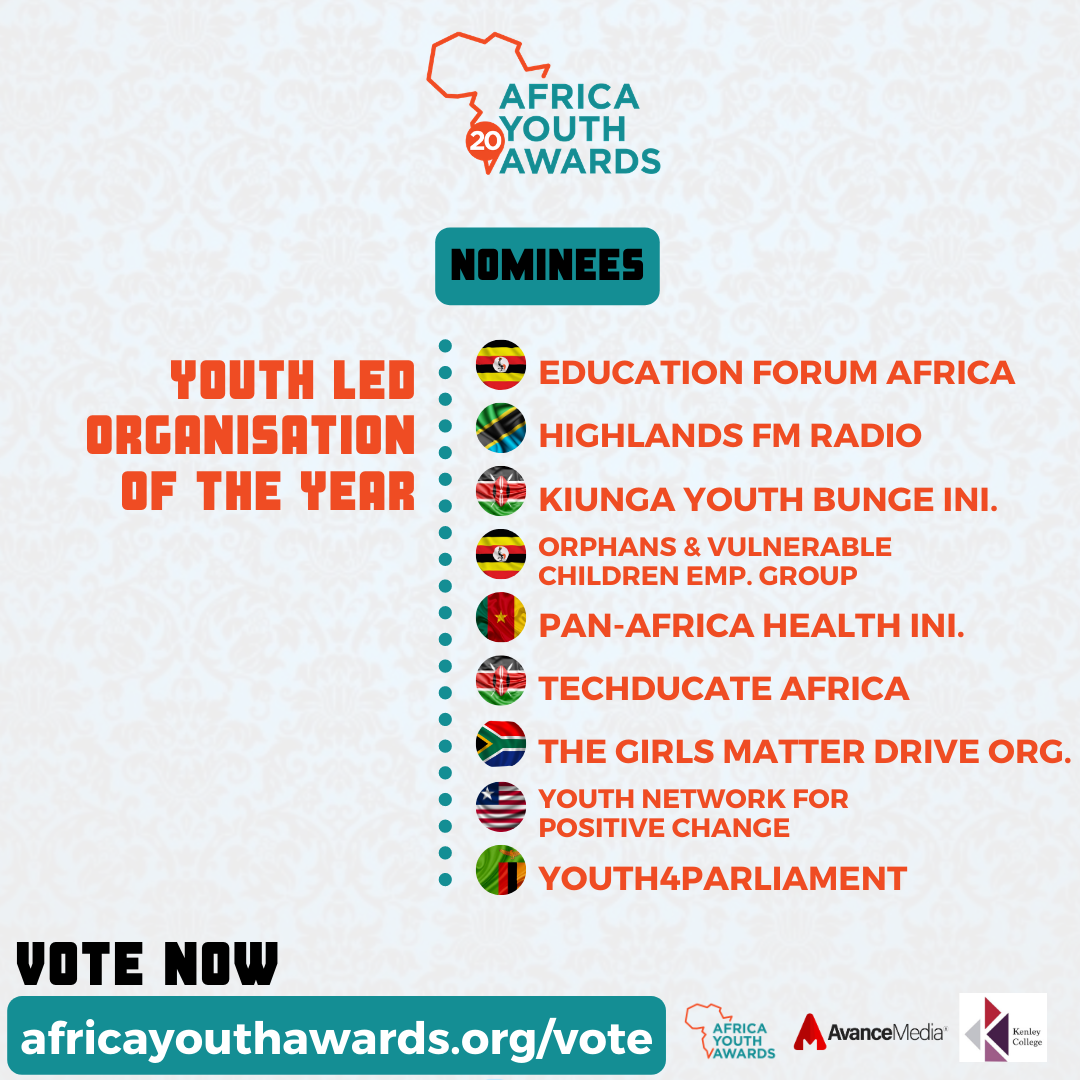
Below are profiles of the 2020 Africa Youth Awards nominees for the YouthLed Organisation of the Year
Category Definition:
To promote youth leadership across the continent, this category is designated to award organisation (both private and public) for the courage in appointing young African to prominent leadership positions. This will be used to throw more light on their exemplary leadership and their belief in young people across the continent.
NB: Profiles were submitted by public nominators
NOMINEES:
EDUCATION FORUM AFRICA
Fully aware of the challenges of knowledge dissemination and appreciation in Africa, bearing in mind our responsibilities as citizens to improve the situation in our communities, we founded Education Forum Africa in 2014 with a belief that education is a lot more than going to school and learning is key to development.
Education Forum Africa has convened a dialogue on ICC and Africa, partnered in hosting the first-ever African Conference of Youth on climate change, contributed to education policymaking in Uganda, empowered the girl child through the keep a girl child in school campaign, selected to host the 2018 young leader’s forum convened annually by the Open Society Initiative for Eastern Africa, organised the first Sustainable Development Goals Run in Africa as a way of creating awareness and it is now held annually since 2017 in Kampala, Uganda and extended educational grants to vulnerable children.
HIGHLANDS FM RADIO
KIUNGA YOUTH BUNGE INITIATIVE
Kiunga Youth Bunge Initiative (KYBI) is an independent non-profit organization established in 2007. It focuses on providing humanitarian interventions, human rights advocacy, security and peacebuilding as its contribution to sustainable development. KYBI was registered and licensed to operate as a community organization in 2011 both in Lamu County in Kenya under the ministry of gender and social services as well as in Jubbaland, Somalia. As a community organization, KYBI is youth-leaning, both in its operations and programs. It is premised on the fact that youth form a critical group of Kenya’s population that are most vulnerable to exploitation, misrepresentation and radicalization.
In delivering on our work along the cross-border region, KYBI considers grassroots’ involvement in sustainable development critical to its operations. Therefore, over the years we invested in creating lasting partnerships and trust within the community along the cross-border corridor. The great success we have experienced is largely attributed not only to the uniqueness and relevance of the design and implementation of our programs but also on the elaborate strategies we use to engage the local communities we work with. Our approach is to create a platform for communities to engage with development stakeholders on a mutually beneficial level with the focus on the community as the sole bearers of solutions that would work for them.
In this regard, we have cultivated strong working partnerships with indigenous communities in the cross-border region.
The ability to also work with established local structures like Nyumba Kumi and Peace Committees has enabled us to build on the sustainability of our programs. We have also established a cross border security committee that has greatly supported processes of resolving cross border issues especially those touching on humanitarian intervention like health care. This, in turn, has greatly enabled mothers from Somalia side to deliver in the Kiunga maternity wing helping to significantly reduce mortality rate on the Somalia side.
ORPHANS & VULNERABLE CHILDREN EMPOWERMENT GROUP (OVCEG)
Orphans & Vulnerable Children Empowerment Group (OVCEG) is a community-based organisation located in Buvuma District founded to mitigate the educational and poverty-related concerns as well as support to improve livelihoods, health, and nutrition standards of critically vulnerable children (OVCs), women and youths in Uganda. OVCEG is also supported by Makerere University Walter Reed Project (MUWRP) under the U.S. President’s Emergency Plan for AIDS Relief (PEPFAR). OVCEG helps the most vulnerable children (560 OVCs), 352 AGYW (Adolescent girls & young women) with HIV/AIDs, 70 Youths groups each with 20-25 members, 1750 adolescent girls and young women (13-24 years), 30 women groups (with men and caretakers)-VSLA of 25-30 members each, female sex workers, transaction sex workers, street/homeless children (reconnection & follow-up project) through education initiatives, agribusiness and home-based income-generating activities. OVCEG supports and works closely with Buvuma District Local Government in Buvuma Health Centre IV, Buwooya Health Centre II, Lubya Health Centre III, and Busamuzi Health Centre III in Buvuma District.
Their project targeted at Orphans and Vulnerable Children (OVC) in primary and secondary schools, their caretakers, vulnerable women/girls of reproductive age and unemployed youths between 15-35yrs. Vulnerable Children have been helped to enrol in Universal Primary Education through building partnerships with Makerere University Walter Reed Project (MUWRP) which had provided a grant supporting over 300 pupils in Kitiko primary school in Buvuma island, constructed a drainage toilet for Kitiko primary school, provided pupils with scholastic materials like books, pens, pencils, school uniforms while supporting their schools with teaching aids like manila papers, chalks, pens and textbooks for the children to read. Caretakers of the OVCs, vulnerable women and girls have been trained on home-based entrepreneurship skills to help them get some income to supplement their children’s education, health and feeding e.g. soap making, poultry, and kitchen gardening among others.
PAN-AFRICA HEALTH INITIATIVE (PAN-AFHI)
Pan-AFHI is a continental membership non-governmental organization with headquarter in Cameroon. Pan-Africa Health Initiative Pan-AFHI is a Pan-African Organization whose aim is to work for the improvement of the quality of healthcare and health systems for all Africans especially those in rural African communities. Pan-AFHI seeks to go beyond addressing the consequences of poor health by understanding, challenging, and changing the conditions that cause poor health and exclusion through its Programs that unites practical work, research, and advocacy. Pan-AFHI believes that people have a right to quality and better health care systems as a basic human need as stated in the Sustainable Development Goals (SDG3), thus we work in a common course for the poor and marginalized including Rural Communities who have been denied and/deprived or simply for some reason or another do not have access to their rights to basic and/or quality health services, to help them understand, challenge and change these conditions. Pan-AFHI’s response to the health challenges of Africa is firmly based on a belief that people themselves are the agents of change and actors of their own development. People’s ability to act on the causes of poor health is what will transform Africa’s future especially our health system. This belief underpins Pan-AFHI’s practical work, its research methodologies, and its advocacy.
The organization started its activities in 2017 and only got legally registered in Cameroon in February 2018. Pan-AFHI has also been legalized in other African countries including Nigeria and Zimbabwe with a network of members which span from diverse African countries. Since registration, Pan-AFHI hopes to be a leader in the improvement of healthcare or rural African communities and the general healthcare systems in these countries.
To ensure the accomplishment of our mission, we implement projects and services in the following lines though they are not exhaustive. Firstly, we work in the domain of HIV/AIDS, TB and Malaria which remain the top cause of death in most African countries especially in rural communities. Secondly, we consider Family health the domain in which we intervene in a wide range of activities including Mother and Child Health, Adolescent Health, Family planning and reproductive health, Sickle cell management and education, General counselling, Diabetes and Hypertension, Palliative care centres, and Counseling and Mental Health. The third domain of activity is Community outreach and Research which include activities such as Health Management in conflict settlings, Outbreak of new and emerging diseases, and Emergency health management. The fourth domain of activity is Disaster management and emergency which include activities like conflict counselling, Disease outbreak management, and Emerging and reemerging diseases.
Lastly, we intervene on Environmental protection and Sanitation with activities such as Water, Sanitation, and Nature and environmental protection.
Pan-AFHI works in partnership with Civil Society Organizations (CSO) and communities and in alliance with other International and continental organizations in Africa and the rest of the world to achieve its aims and objectives. Pan-AFHI has established a wide range of partnership with local and international organizations which include Teaching Artists Institute (TAI), Global Medical Library (GML), Vengo Center for Youth Empowerment and Development Association (VeCEDA), Our Health Foundation, Ministry of Publish Health Cameroon, etc.
TECHDUCATE AFRICA
Techducate Africa works to create digital literacy through education -technology in underserved communities. The team consists of six young women from different backgrounds all aged between 20 years and 28 years old. Techducate Africa has been able to capture the attention of people through its project-based learning approach and its ability to create an impact in over 100 students and their families in just one year of operation. The team has demystified computer literacy and inspired many young people to create change in their communities. Mariachana is resilient, smart, creative and determined enough to make a great impact in Kenya and Africa as a whole.
Techducate Africa was chosen for The Future is Female Mentorship Program 2020 by CMOORE MEDIA which trains and mentors 12 African Female-Led Tech start-ups from all over Africa, won the Youth Engagement Society Start-up Grant 2019 and has impacted over 100 students, their schools and communities to use technology to educate themselves and create economically viable projects.”
THE GIRLS MATTER DRIVE ORGANISATION
The Girls Matter Drive Organisation was birthed by a young woman by the name of Edwina Mlondobozi who has the love and compassion for young people and cares for their needs/rights. She has an immense interest in shaping the lives of young people who come from disadvantaged backgrounds. “It is time to show these young people what they are worth!” She quotes
Girls Matter Drive looks to touch the lives of many young people and provide a support system of hope and encouragement through each of its programs. This will start by building their confidence through fighting for girls/women’s rights, providing sanitary products, food parcels and also teaching them life skills. With hopes to teach and empower these young ladies by helping them flourish into amazing women that will do great things in the future of this country. • We want the girls to become self-sufficient adults, equipped with the capacity
to continuously evolve emotionally, physically and spiritually; building strong family units; developing a strong support system; and contributing to community life. Michelle Obama once said, “When women are educated, their countries become stronger and more prosperous.”Hence we believe in empowering and supporting young women.
Our values serve as a compass for our actions and describe how I behave in the world.
- Education opportunities and enrichment experiences will lead to economic self-sufficiency, quality of life and general well-being.
- We embrace the diversity of culture, perspective and experience and realise that differences define the richness and vitality of life.
- The needs of our girls’ dictate Girls Matter Drives’ service development. We
acknowledge a society that is fraught with social barriers of class and gender. We celebrate the uniqueness of the female spirit, while advocating for positive changes for girls and communities.
YOUTH NETWORK FOR POSITIVE CHANGE
Youth Network for Positive Change (YOUNETPO) is a registered and accredited youth-led civil society organization in Liberia. The organization mission is to promote youth education and empowerment through skills and capacity development, volunteerism and advocacy, thus re-orientating the youths to be productive citizens, thereby sustaining the peace and transforming our society to create positive change and its vision is to create a self-sustaining generation of youth by helping them to realize their full potential through equal access to education and opportunities.
The organization activities are overseen by a group of well qualified young individuals; Its staff/volunteers members have ties to the community, and thus possess the unique ability to relate to the target demographic. Additionally, YOUNETPO has a total of 10 staffs; all are youth between the ages of 18-29 years. Board of Directors is comprised of a professional group of talented individuals who are dedicated to committing their time and resources to build stronger communities (their ages range 35-40 yrs.).
The organization programs and projected has benefited over 10,000 girls, women, men and boys between the ages of 10-30 years; have impacted over ten (10) communities in Montserrado, Margibi and Grand Bassa Counties; impacted sixty-eight (68) schools in Montserrado County through the Montserrado Bee Project (Primary, Junior and Secondary Schools).” “Youth Network for Positive Change (YOUNETPO) programs and projected has benefited over 10,000 girls, women, men and boys between the ages of 10-30 years; have impacted over ten (10) communities in Montserrado, Margibi and Grand Bassa Counties; impacted sixty-eight (68) schools in Montserrado County through the Montserrado Bee Project (Primary, Junior and Secondary Schools) since its Establishment in 2014.
YOUNETPO has worked with the government of Liberia, institutions such as Institute for Research and Democratic Development (IREDD), Youth Alive Liberia (YAL), Helping Hand Liberia (HHL), Environmental Protection Agency of Liberia (EPA), United Nations Development Programme (UNDP), Open Society Initiative of West Africa (OSIWA) and the National Endowment for Democracy (NED) etc in delivering services throughout Liberia during the implementation of the following projects, few of which are listed below:
YOUTH4PARLIAMENT
Youth4Parliament is a grassroots social movement that has been working on enhancing the participation of young people in politics and governance in Zambia. The movement was founded as a direct response to the continued shrinking civic and political space for the youth in Zambia, with a primary focus of increasing the presence of young people in parliament and providing a platform where they can have meaningful engagements in civic and political matters. It has a network of over 60,000 grassroots community organizers and mobilizers (young politicians, Youth Parliamentarians, youth activists, students) across all the 10 provinces in Zambia. Zambia’s laws are formulated by the legislative wing of government, which is Parliament, the parliament is also in charge of oversight on most developmental programs carried out by the government, and also reviews formulated policies by the government. The Zambian Parliament consists of only 3 elected youths out of 156 elected members of Parliament, and none from the 8 nominated members of parliament. This figure represents 1.8%. The lack of youth representation undermines the voice of young people in national matters, to that end, the laws, policies and development projects may be tailored in such a way that does not speak to about 37% of the population, this is not a negligible statistic.
“One of the key milestones which the movement has attained within a short period of its existence is the signing of a “Social Contract” by Secretary Generals representing seven (7) major political parties in Zambia, which include; the ruling party, Patriotic Front –PF, the United Party for National Development – UPND which is the major opposition party in parliament and five (5) other political parties.
The “Social Contract” provides for entry points for young people in their political parties and guarantees them of consideration and subsequent adoption for them to contest for parliamentary seats in the 2021 General Elections.
The social contract has so far led to an election of 1 youth below the age of 35 as Member of Parliament in a by-election in 2021, it has led to the nomination and subsequent election of a 21yr old female to the position of National Spokesperson of the Socialist Party of Zambia which is one of the major opposition political parties that signed the social contract with Youth4Parliament.
Another milestone that Youth4Parliament has attained was the invitation to the Fifth Inter-Parliamentary Union (IPU) Global Conference of Young Parliamentarians held in Baku, Azerbaijan, on 14 and 15 December 2018. Youth4Parliament was invited as panellists to make a presentation on the importance of greater youth participation in parliaments and how young MPs can work with civil society to bring about change to this end. The movement was also invited to make a presentation at the Ministry of Foreign Affairs of Denmark and Global Focus Conference to “elaborate on why democratic participation for youths is essential, and how Youth4Parliament works to secure the involvement of Youths in decision-making processes in Zambia”. The conference centred around the global trend of shrinking space and the movement presentation focus on claiming civic space about the 2030 Agenda and highlighting the inter-linkages between civic space, SDG 16 and other SDG’s.

Leave A Comment